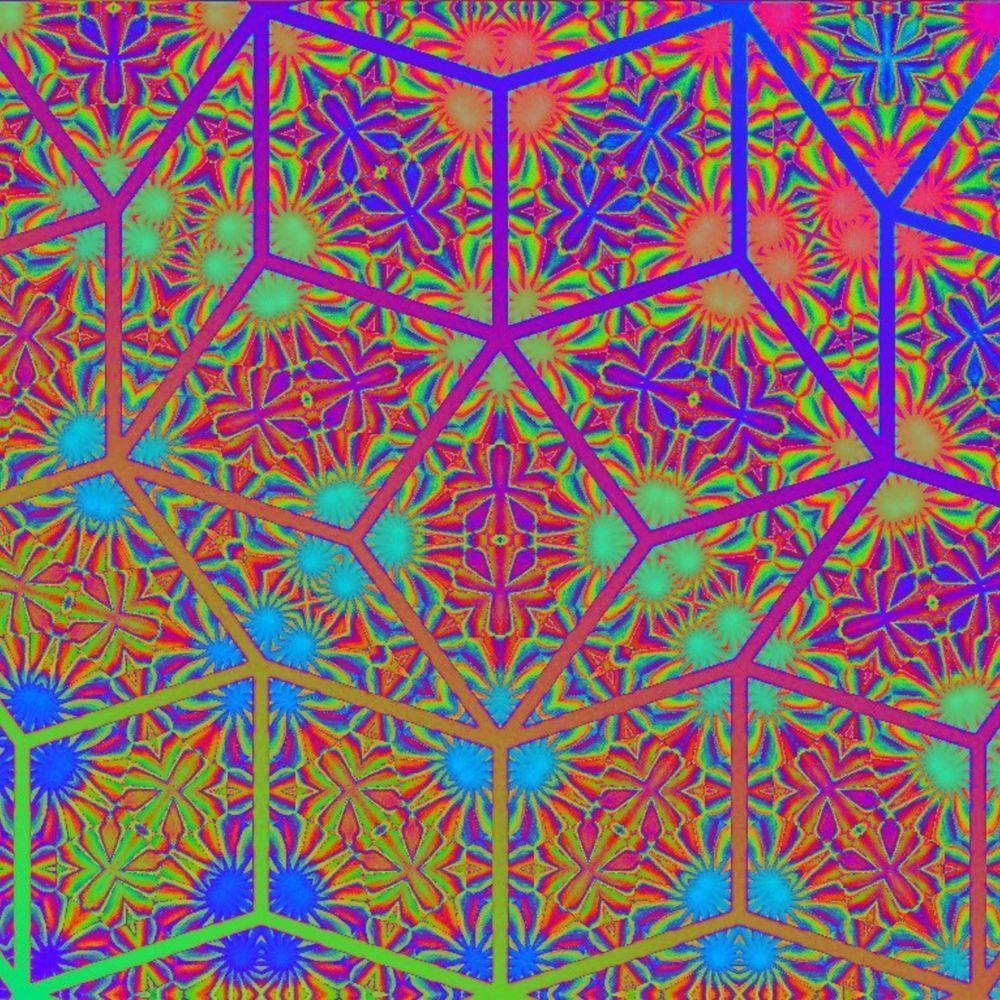
There is something quietly insurgent about Fractured Bloom — a work that looks like a celebration and a map at once. When I first set out to compose it, I wanted to capture that exact contradiction: petals insisting on freedom while lines insist on structure. The result is a mosaic of motion and restraint, a kaleidoscope that refuses to sit still.
Look closely and you’ll see the conversation between geometry and organic form. Bold, almost architectural divisions slice the surface into facets; inside each, floral motifs explode in chromatic murmurs. The colors don’t just sit next to one another — they pulse, vibrate, and refract, so that the pattern reads differently depending on where you stand and how the light hits it. It’s both a labyrinth and an invitation: follow a line and you’ll find new gardens; lose the line and you’ll find an untamed meadow.
There’s an emotional undercurrent here, too. The “fracture” in the title isn’t damage so much as a condition of growth — fragmentation as a way to hold more light. I often think of how ecosystems heal in pieces, how community mends by reconnecting smaller parts. That idea quietly guided the palette and the composition: bright, hopeful bursts threaded through ordered compartments. It’s a balance of tension and tenderness, meant to provoke reflection as much as delight the eye.
A few notes about how Fractured Bloom lives in space: it’s the kind of piece that ignites a neutral room or deepens an already saturated one. Hang it where people pass through and pause — a hallway, a reading nook, or above a fireplace. Soft, directional lighting brings forward the texture and lets the colors vibrate without overwhelming the room. In a gallery, it asks viewers to move around it; in a home, it becomes a daily prompt to notice the small tessellations of our lives.
Sustainability matters to me, and it’s woven into how I bring works like this into the world. Whenever possible, I choose materials and processes with lower environmental impact: recycled substrates, archival inks with reduced emissions, and framing approaches that favor longevity over disposability. Art that speaks of natural cycles should honor those cycles in its making.
If Fractured Bloom speaks to you, consider how you’d like to live with it. Do you prefer a restrained frame to emphasize the geometry, or a float-mount to let the colors breathe? Would you like a print scaled for a compact space, or a large statement piece that anchors a room? I’m always happy to discuss options and to create pieces that respond to your space and story.
Finally, let me leave you with this: what does a bloom look like when it is allowed to break apart and become more itself? For me, it looks like this — fractured, radiant, and unashamedly alive.